
Elevenfold Legacy
Build your XI. Leave your mark.
Building a persistent football world, not just a match simulator
An asynchronous football management game built around a custom simulation engine, persistent club state, tactics, progression and multiplayer systems. A larger long-term product where game logic, backend infrastructure and the web experience evolve together.
Open Elevenfold Legacy(opens in a new tab)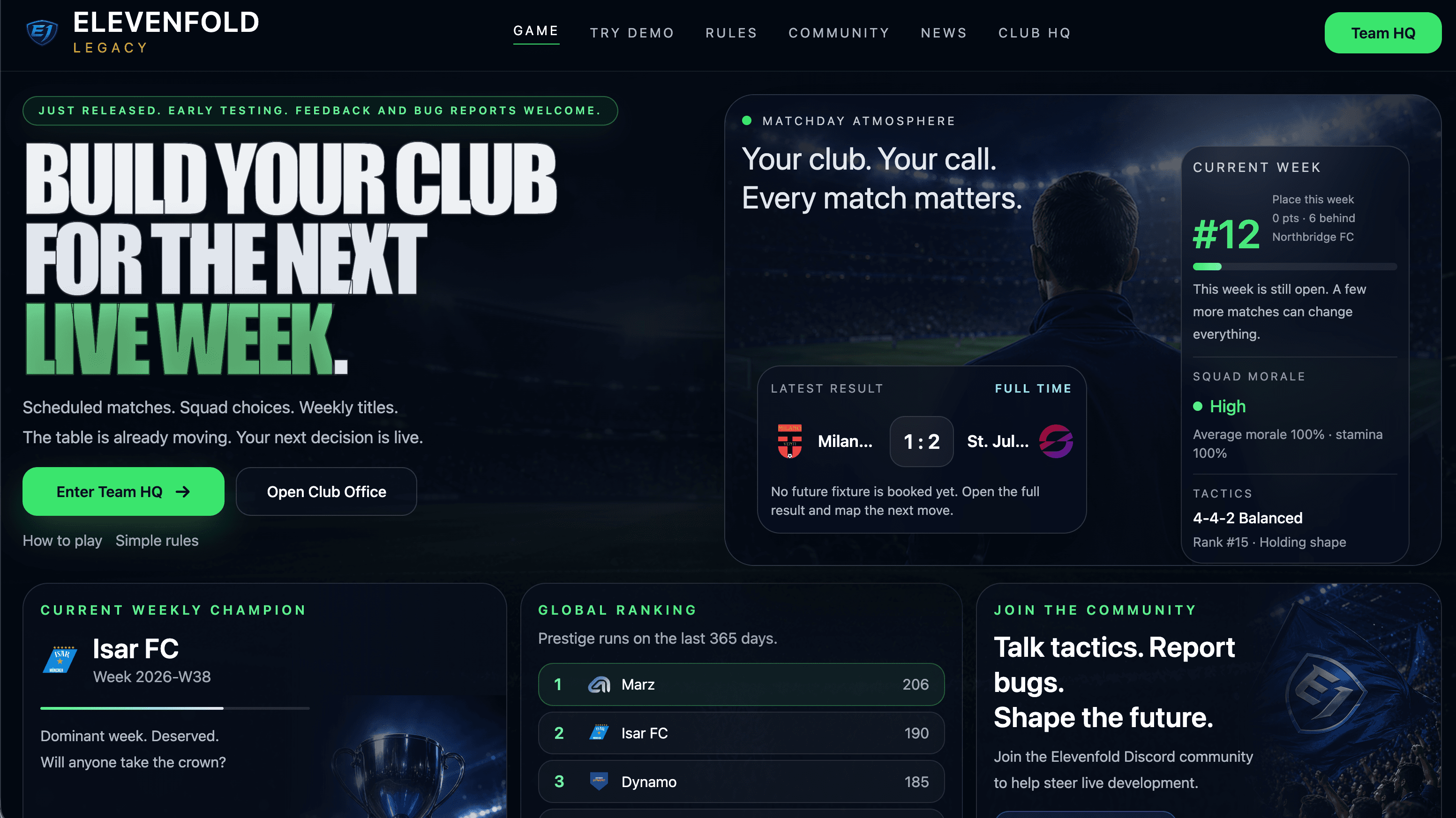
My role
Creator, product designer and sole engineer
I created the product concept, game systems, architecture, data model, web application and game engine.
What I built
- Club and squad creation
- Players, teams and squad management
- Formations and tactics
- Drag-and-drop starting XI and substitutes
- Player development
- Match simulation
- Leagues, seasons, challenges and rankings
- Asynchronous multiplayer flows
- Authentication and persistent user state
- Backend request processing
- Firebase infrastructure
- Scheduled jobs
- Payment and subscription integration
- Isolated development and production environments
- Public landing page and no-login demo/onboarding flow
Main technical challenge
Build a coherent stateful multiplayer system rather than an isolated feature. Persistent player and team state, deterministic game logic, server-side match simulation, asynchronous actions, scheduled jobs, realtime updates, permissions, progression and the economy all need to remain consistent.
Architecture
- apps/web — Next.js web application
- functions — Firebase Cloud Functions and asynchronous operations
- packages/engine — reusable TypeScript football and game logic
- Firestore and Storage security rules
- Separate development and production Firebase environments
Current product
The public landing page and no-login match mission are live. Core club creation, squad management, match systems, progression infrastructure and backend flows are functional, while the product remains in active development and early testing.
Lessons learned
- Designing a larger interconnected product
- Separating game engine, user interface and infrastructure
- Complex Firestore data modelling
- Cloud Functions and scheduled backend flows
- Realtime and asynchronous state
- Multiplayer product architecture
- Payments and environment separation
- Using AI coding agents in a large codebase without delegating architecture or product judgment